Anglican Bishop to Swim Tiber on Advent4
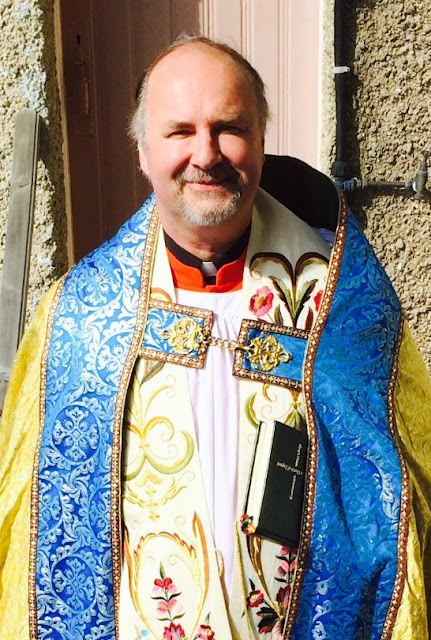 |
| Ashenden/Anglican Ink |
(Ashenden) said he was helped in his conversion by taking up the Rosary and by looking into Eucharistic miracles. “The fact that [the miracles] were unknown amongst those who celebrated the Anglican version of the Eucharist, carries obvious implications,” he wrote.
After failing to find a way to unite orthodox Anglicans into one ecclesial grouping, Ashenden also came to appreciate the Magisterium of the Catholic Church: “I came to realise (too long after both Newman and Chesterton had already explained why) that only the Catholic Church, with the weight of the Magisterium, had the ecclesial integrity, theological maturity and spiritual potency to defend the Faith, renew society and save souls in the fullness of faith.”
Ashenden will be received into the Church by Bishop Mark Davies at Shrewsbury Cathedral. Bishop Davies told the Church Militant website it was “very humbling to be able to receive a bishop of the Anglican tradition into Full Communion in the year of the canonization of Saint John Henry Newman.”
Welcome home, Gavin Ashenden!
Popular Posts
In the Personal Ordinariate of the Chair of Saint Peter, the September Ember Days are the traditional Autumn Ember Days, observed on the Wednesday, Friday, and Saturday following the Feast of the Exaltation of the Holy Cross (September 14). They remain part of the Ordinariate's liturgical patrimony and are specifically encouraged for prayer, fasting, repentance, thanksgiving for the harvest, and prayers for vocations. For 2026, those days (Embertide) fall on: Wednesday, September 16 Friday, September 18 Saturday, September 19 The Ordinariate explains that the September Ember Days are associated with the grape harvest, directing our gratitude toward the wine that becomes the Precious Blood in the Holy Eucharist. They are also traditional times to pray for priests, deacons, and future vocations. Discipline Regarding discipline, the Ordinariate notes that Ember Friday is a day of obligatory abstinence from meat. The faithful are also encouraged to undertake additional fasting, prayer...
Attendees of the Ordinariate Mass habitually pray the Nicene Creed during the Sunday Mass. Since becoming a regular at the Ordinariate Mass, I am reminded every week how blessed we in the Ordinariate are by having a beautiful translation of the Creed to pray. While still a diocesan Catholic, I remember with joy and satisfaction the introduction of the revised (some might say a restored) English translation of the Creed for the Ordinary Form of the Mass. When I left diocesan precincts for the Ordinariate, I found the Credo as prayed in Divine Worship (DW), the Mass of the Ordinariate, to be awkward at first, though strangely attractive. The DW version motivated me to slow down and revisit each phrase. Having been exposed to and shaped by the Credo of Divine Worship for a few years now, I cannot imagine returning to even the improved English text of the Ordinary Form Liturgy. The Nicene Creed professed in the Ordinariate, in that older liturgical dialect, is lyrical, confide...

Screenshot | Artistic impression of Medieval Priory built beside the Holy House (Denny) The Foundation of the Chapel of Walsingham The Pynson Ballad, published by Richard Pynson circa A.D. 1485* https://www.walsinghamanglicanmedieval.org.uk/pynson.htm https://web.archive.org/web/20080725010750/http://www.walsinghamanglicanarchives.org.uk/pynsonballad.htm http://devotiontoourlady.com/shrine-of-walsingham.html Of this chapell se here the fundacyon, Bylded the yere of crystes incarnacyon, A thousande complete syxty and one, The tyme of sent Edward kyng of this region. Beholde and se, ye goostly folkes all, Which to this place have devocyon When ye to Our Lady askynge socoure call Desyrynge here hir helpe in your trybulacyon: Of this hir chapell ye may se the fundacyon. If ye wyll this table overse and rede Howe by myracle it was founded indede. A noble wydowe, somtyme lady of this towne, Called Rychold, in lyvynge full vertuous, Desyred of Oure Lady a petycyowne Hir to honoure with some w...
St Mary the Virgin Parish, Arlington, TX At the Mass we discover that friendship is not something we manufacture for ourselves. Rather, it is a gift received while seeking God together. In an age marked by loneliness and fleeting connections, many people long for genuine friendship. Social media promises constant contact, yet countless hearts remain isolated. True friendship requires more than shared interests or casual conversation. It is founded upon a common pursuit of what is good, true, and beautiful. For Christians, there is no greater place to discover such friendship than in the Holy Mass. We come not to socialize but to worship Almighty God. The focus is not on ourselves but upon the sacred mysteries unfolding at the altar. Yet it is precisely this common orientation toward God that creates the deepest form of human fellowship. The liturgy teaches us that we are not isolated individuals approaching God alone. We gather as members of Christ's Body. Together we confess our s...

The voice of God in Holy Scripture is never a mere sound; it is the living self‑communication of the Lord who speaks to His people in order to create, judge, redeem, and sanctify. Across the canon, God’s voice is portrayed as both transcendent and intimate—majestic in power yet directed personally to the human heart. The Voice that Creates and Commands From the opening lines of Genesis, God’s voice is the medium of creation: “And God said…” (Gen 1). Divine speech is performative; it brings reality into being. Scripture thus presents the world not as a random emergence but as the ordered result of God’s articulate will. The same creative voice later gives the Law at Sinai (Exod 19–20), revealing that the One who speaks worlds into existence also speaks covenantal commands that shape human life. The Voice that Reveals and Interprets The prophets repeatedly describe their vocation as hearing and transmitting the word of the LORD (Jer 1:4–10; Isa 6). God’s voice is revelatory: it discloses...

The Catholic Church is called to welcome every person because every human being is created in the image and likeness of God. Christ Himself demonstrated this hospitality throughout His earthly ministry. He dined with tax collectors, spoke with sinners, touched lepers, and welcomed those whom society had rejected. The Church, as the Body of Christ, is therefore called to extend the same invitation to all people without exception. Authentic hospitality begins with recognizing the inherent dignity of every person. Regardless of background, past mistakes, social status, beliefs, or personal struggles, each individual is loved by God and is invited into a relationship with Him. A parish community should be a place where newcomers are greeted warmly, where questions may be asked without fear, and where people can encounter the mercy and truth of the Gospel. Jesus welcomed sinners, but He also called them to conversion. At the same time, genuine Christian hospitality is not mere acceptance o...
POPE LEO XIV Magnifica Humanitas
Even in the darkest nights, the Lord raises up men and women who refuse to give up, who persevere in doing good, who protect the vulnerable and open pathways to reconciliation. The memory of the saints, righteous people and the oft-forgotten peacemakers, show us that grace does not magically eliminate conflict, but instead it inspires active resistance to evil and an astonishing creativity in doing good” (paragraph 211).
WILLIAM SHAKESPEARE
I doubt not then but innocence shall make false accusation blush, and tyranny tremble at patience.
WORDS TO THE WHYS
You cannot subsidize irresponsibility and expect people to become more responsible. Thomas Sowell
EPICTETUS
If anyone tells you that a certain person speaks ill of you, do not make excuses about what is said of you but answer, "He was ignorant of my other faults, else he would not have mentioned these alone."


Comments
Post a Comment
Your comments will be appreciated and posted if 1) they are on topic and 2) preserve decorum.
Stand by your word.