Posts

Showing posts with the label Literature

WORDS TO THE WHYS

Reality is not optional. Thomas Sowell

Frankly No

Image
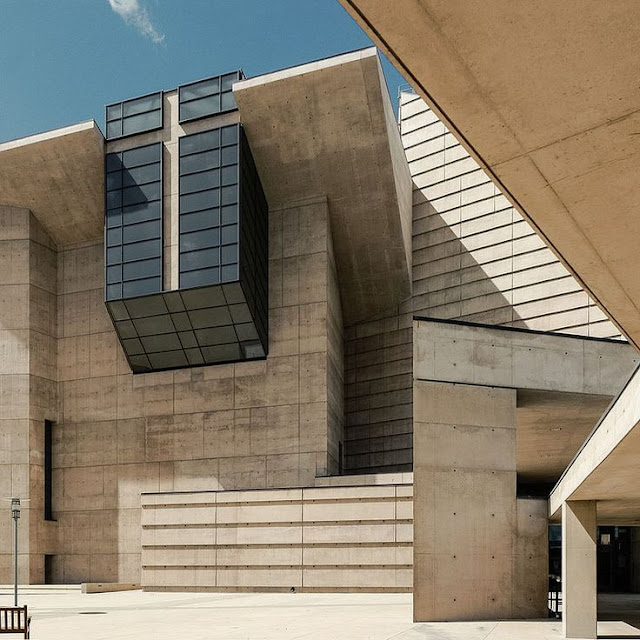
Los Angeles Cathedral | Ximo Michavila photo [ 5 minute read ] Pope Francis, i.e., to be Frank, has dug a very large hole and filled it with not an insignificant amount of silliness for the next pope - whoever that might be - to step into. The word of the season is, of course, the word 'confusion'. Here's another word which, by now, is entirely familiar to concerned Catholics: mess. Christmas 2023 was turned into Crassmess by that now infamous document issued by the DDF, written by Cardinal Tucho the eroticist. Eroticist, to put it politely. Here is another word: chaos. Chaos: the state of things wherein faithful Catholics are tempted to indulge a variety of useless distractions, emotions, and what-have-you, as a result of the introduction of the imprudent actions of hierarchs who should know better than to put souls at risk. Candy Not Candy We Catholics are not prudes. Witness the sublime Catholic art of Michelangelo, for starters, and his virtuosic respect for and renderi...

Orwell On Wodehouse

Image
P.G. Wodehouse | Britannica "I just sit at a typewriter and curse a bit." P. G. Wodehouse P. G. Wodehouse is widely regarded as the greatest comic author of the 20th century. Hilaire Belloc, no less, called him ‘the head of my profession’. This high respect from his peers, past and present, is principally for his supreme command of the English language. Wodehouse wrote more than 70 novels and 200 short stories, creating numerous much-loved characters - the inimitable Jeeves  and Wooster, Lord Emsworth and his beloved Empress of Blandings, Mr Mulliner, Ukridge, and Psmith. His humorous articles were published in more than 80 magazines, including Punch , over six decades. Oh, and he was also a highly successful musical lyricist. PG Wodehouse Society In Defence of P. G. Wodehouse (1946) by George Orwell "There is an old saying that if you throw enough mud some of it will stick, and the mud has stuck to Wodehouse in a rather peculiar way." When the Germans made their ra...

Tolkien: a founder of clubs, a model for evangelization

Image
The Apolausticks An article by Michael Gilleland ,  October 17, 2008 Peter Gilliver et al., The Ring of Words: Tolkien and the Oxford English Dictionary (Oxford: Oxford University Press, 2006), p. 39, n. 7, on The Coalbiters , a club founded by Tolkien ( in 1912 ) to read Norse sagas: The club's name derives from the Icelandic KolbĂ­tar , a name given to those who stay so close to the fire in winter that they are virtually 'biting the coal'. This was not the first club with a linguistically intriguing name which Tolkien had founded: during his undergraduate days at Exeter College he had founded the 'Apolausticks'—from the word apolaustic 'devoted to seeking enjoyment', which, since it is extremely rare, he may well have discovered in the OED. Tolkien started out as a student of the classics, and he also may well have discovered the word in the beginning of Aristotle's Nicomachean Ethics (1.5.1-2, tr. H. Rackham): On the one hand the generality of men an...

A Few Telling Tidbits

Image
Pope Trudeau | AP The Generational Divide in the Priesthood by Darrick Taylor That younger priests are drawn to the older rite and to traditional spirituality I have long known, but seeing this priest made visible for me the generational divide within the priesthood today. It is one of those topics that can be delicate to speak of but is almost impossible to ignore: younger priests care more about orthodoxy, liturgy, and tradition than those ordained in previous decades. Many could produce anecdotes like the one above, but a recent survey of priests in the United States confirms this. https://www.crisismagazine.com/2022/the-generational-divide-in-the-priesthood https://papers.ssrn.com/sol3/papers.cfm?abstract_id=3951931 The Politicization of Ad Orientem by Eric Sammons When I first arrived at the Diocese of Venice, my family were happy Novus Ordo-attending Catholics. We explored the parishes around us, but what we found were variations on the same theme: the priest was a performer, cel...

Tea with Evangelicals, from Loss and Gain

Image
Loss and Gain (1848) by (Saint) John Henry Newman Loss and Gain is a philosophical novel by John Henry Newman published in 1848. It depicts the culture of Oxford University in the mid-Victorian era and the conversion of a young student to Roman Catholicism. The novel went through nine editions during Newman's lifetime, and thirteen printings. It was the first work Newman published after his conversion to Roman Catholicism in 1845. - WP Chapter 17: from the Newman Reader FREEBORN was not the person to let go a young man like Charles without another effort to gain him; and in a few days he invited him to take tea at his lodgings. Charles went at the appointed time, through the wet and cold of a dreary November evening, and found five or six men already assembled. He had got into another world; faces, manners, speeches, all were strange, and savoured neither of Eton, which was his own school, nor of Oxford itself. He was introduced, and found the awkwardness of a new acquaintance litt...

John Lydgate

Image
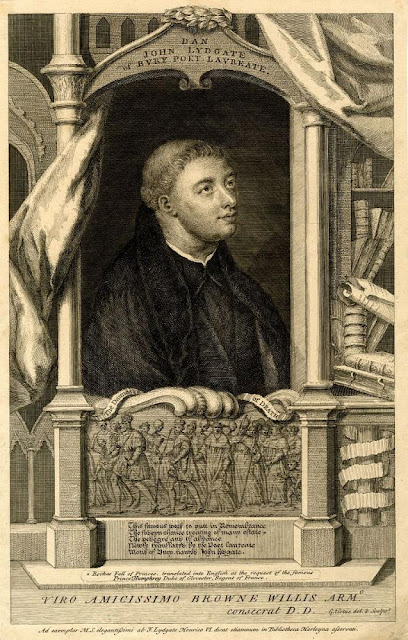
John Lydgate, monk and poet, enjoyed significant fame during his lifetime, at times exceeding the reputation of Chaucer. John Lydgate, (born c. 1370, Lidgate, Suffolk, Eng.—died c. 1450, Bury St. Edmunds?), English poet, known principally for long moralistic and devotional works. In his Testament Lydgate says that while still a boy he became a novice in the Benedictine abbey of Bury St. Edmunds, where he became a priest in 1397. He spent some time in London and Paris; but from 1415 he was mainly at Bury, except during 1421–32 when he was prior of Hatfield Broad Oak in Essex. Lydgate had few peers in his sheer productiveness; 145,000 lines of his verse survive. His only prose work, The Serpent of Division (1422), an account of Julius Caesar, is brief. His poems vary from vast narratives such as The Troy Book and The Falle of Princis to occasional poems of a few lines. Of the longer poems, one translated from the French, the allegory Reason and Sensuality (c. 1408) on the theme of ch...

Speaking of the Ordinariate: Part 2 - Digestives

Image
David Low (1928) Chesterton More Ordinariate Speak (accompanied by an unnecessary pronunciation guide). Issue: ISS-syoo Mystery: MISS-tree Temptation: tem(p)-TAYS-see-on or tem(p)-TEH-see-on Digestives for High Tea Slices of Englishness for Casual Conversation Byrd : BURD William Byrd (c.1539/40 or 1543 – 1623), was an English composer of the Renaissance. He wrote in many of the forms current in England at the time, including various types of sacred and secular polyphony, keyboard (the so-called Virginalist school), and consort music. Although he produced sacred music for Anglican services, sometime during the 1570s he became a Roman Catholic and wrote Catholic sacred music later in his life. Chesterton : CHESS-ter-ton Gilbert Keith Chesterton (1874 – 1936) is a writer like none other. As a journalist, he wrote thousands of essays for the London newspapers. But he also wrote a hundred books: novels, poetry, plays, literary criticism, history, economic theo...

POPE LEO XIV Magnifica Humanitas

Even in the darkest nights, the Lord raises up men and women who refuse to give up, who persevere in doing good, who protect the vulnerable and open pathways to reconciliation. The memory of the saints, righteous people and the oft-forgotten peacemakers, show us that grace does not magically eliminate conflict, but instead it inspires active resistance to evil and an astonishing creativity in doing good” (paragraph 211).

LUCIUS ANNAEUS SENECA

The greatest remedy for anger is delay.

WILLIAM SHAKESPEARE

I doubt not then but innocence shall make false accusation blush, and tyranny tremble at patience.