Posts

Showing posts with the label Unity

WORDS TO THE WHYS

Reality is not optional. Thomas Sowell

The Personal Ordinariates: Unity, Diversity, Harmony.

Image
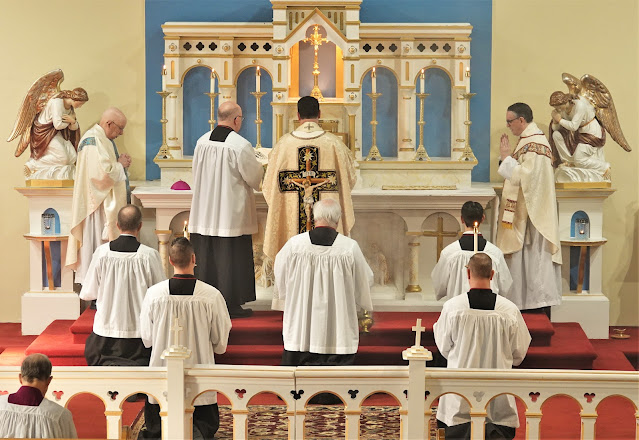
St. John the Baptist Catholic Church, Bridgeport, PA In 2023, Monsignor Keith Newton, then head of the Personal Ordinariate of Our Lady of Walsingham, coined the term “realized ecumenism” to describe how the Ordinariates created by the Apostolic constitution Anglicanorum Coetibus offer a welcoming path for those seeking the fullness of the Faith. https://ewtn.co.uk/article-the-head-of-the-ordinariate-for-former-anglicans-in-england-and-wales-assesses-its-past-present-and-future/ The Personal Ordinariates represent one of the most quietly remarkable ecumenical achievements of the last century: a form of unity that does not require amnesia. They embody a model of reconciliation in which distinct traditions are not dissolved but transfigured — brought into full communion without losing the theological, liturgical, and pastoral instincts that shaped them. The Personal Ordinariates are a quiet work of the Holy Spirit, gathering what was once separated and transforming it into communion. Th...

Anglicans of The Catholic League Speaking On The Council Of Trent

Image
A post on the Anglican Ordinariate Forum Facebook site included a link to The Creed of the Council of Trent with Explanations , which served as the inspiration for this blog post. The Creed of the Council of Trent with Explanations (CCTE) Published by The Catholic League L.G. Fisher, Gen. Sec. 40, Barmead Road, Beckenham, Kent Background. The Catholic League was established within the Church of England to encourage unity among all Christians with the See of Rome. The League was established in 1913 with 97 founding members, led by Richard Langford-James and Henry Fynes-Clinton. It followed earlier groups like the Association for the Promotion of the Unity of Christendom (founded in 1857) and the Guild of the Love of God (founded in 1911). According to the League, it was started by Anglicans who strongly believed that the future of their Church depended on reuniting all Christians in a shared Catholic and Apostolic faith, fully restored in communion with the Successor of Peter in Rome. C...

A Prayer For Our Anglican Brothers And Sisters

Image
Heavenly Father, God of truth and mercy, thou knowest the thoughts of all and knowest our necessities; in Thy boundless love, grant unto those souls wrestling with the late tidings within the Anglican Communion that their hearts and minds be drawn towards accord in Thy sacred truth; bestow upon them the graces requisite to pursue Thy divine intent, and upon us, who labour for concord 'mongst all professing disciples of Thy Son, grant us the means to find and bid welcome to all who seek assurance and fellowship in the truth, and divine consolation in the unchanging doctrine handed on by the Apostles; through Jesus Christ our Lord, who liveth and reigneth with Thee in the unity of the Holy Ghost, ever one God, world without end. Amen.

Pray for Canada's Delegates to the Synod On Synodality

Image
Hand of God, from a fresco at Saint Clement of Taüll, Catalonia. Almighty God and Father, vouchsafe to grant Thy servants the grace that illuminates minds and conforms wills to the truth revealed by Thy Son our Lord and Saviour Jesus Christ. Pour forth Thy Holy Spirit to guide them and all Synod delegates in perfect faithfulness to the Apostolic Tradition for the glory of Thy Name, for the unity of the Body of Christ, and for the salvation of souls. In Jesus' Name. Amen. Hail Mary... Glory be... Holy Michael, archangel... His Eminence Gérald Cyprien Cardinal LACROIX, I.S.P.X., Archbishop of Québec His Grace John Michael MILLER, C.S.B., Archbishop of Vancouver The Most Reverend William Terrence McGRATTA, Bishop of Calgary The Most Reverend Raymond POISSON, Bishop of Saint-Jérôme - Mont-Laurier The Most Reverend Marc PELCHAT, Auxiliary Bishop of Québec, Titular Bishop of Lambesi The Reverend Gilles ROUTHIER, professor in the Faculty of Theology and Religious Studies at Laval Universi...

Mass Identity

Image
Q. When are we most Catholic? A. We are our most true selves when we are in the Mass worshipping God. There we are humbled before God and embraced by our Maker; are grateful recipients of God's sustaining grace, His very life, the Body and Blood of Jesus Christ; recognize we can do nothing without God; acknowledge our utter dependence on God for our salvation and eternal life; are commissioned to serve the mission of Christ and His Church, the salvation of souls. The reasons for which Mass is offered are: to adore God as our Creator and Lord. to thank God for His many favors. to ask God to bestow His blessings on all men. to satisfy the justice of God for the sins committed against Him. to cooperate with God for the salvation of souls. Catholic Worship is oriented to God the Holy Trinity, to the Father through the Son in the Spirit. Liturgy is “medial”—that is, neither pure activity on our part, nor pure passivity, but both and neither, like the “middle voice” of some ancient langu...

The twain shall never meet?

Image
Dichotomy Catholic Neophilia - everything new is great. Catholic Neophobia - everything new is bad. In fairness, Catholic neophiliacs fear the old as much as they love the new. Likewise, Catholic neophobes fear the new as much as they love the old. Not everything new is bad; not everything new is great. Not everything old is bad; not everything old is great. Now that that's all said, let's move on. The recent struggles of Latin Mass enthusiasts are so very unfortunate, and unnecessary. How can 'the old' be a threat unless those who consider 'the new' to be so fragile that highly proscriptive measures are imposed (necessary?) to make 'the threat', i.e., 'the old', go away so that the new may flourish? The following equation is unfounded. It is math that frequently finds a home among neophiles in the blogosphere. Latin Mass enthusiasts appreciate the older Form, ∴ their preference constitutes a rejection of the new Mass produced by the Consilium co...

Five Fares For A Friday

Image
An Outline of Ascetical Theology According to the English Pastoral Tradition  (London: S.P.C.K., 1963), xiv. Martin Thornton Preface At the heart of Anglicanism is the insistence on historical continuity; if our claims are true then our spirituality, that is our total expression of Christian life, as well as our theology, liturgy, and polity, must be retraceable through the medieval and patristic ages to the Bible. I have tried, therefore, to portray the English School as a living tradition, drawing its inspiration and character from all ages, while set within the glorious diversity of Catholic Christendom. Rather than preoccupation with the past, I believe that it is this comprehensive view which can inspire creative insights into the spiritual needs of the twentieth century: a good tree, especially an ancient one, bears new fruit only when attention is paid to its roots. Not the Pleasantly Social, but the Truth Anthony Esolen To search for truth, to guard and study it when it is ...

I, when I am lifted up from the earth, will draw all men to myself.

Image
The Holy Gospel according to St. John 12:32 (A)nd I, when I am lifted up from the earth, will draw all men to myself. Former Baptist Pastor (John Thompson) Explains His Conversion to Catholicism https://www.ncregister.com/blog/john-thompson-former-baptist-pastor-becomes-catholic I went back and looked at worship in the early Church. I expected to find the Baptist Church with preaching and worship that reflected Baptist beliefs. Yet I found that the earliest post-Scriptural documents that we have speak of liturgy from the very beginning. You don’t find the free worship of the Baptist or the Evangelical tradition. You find the liturgy, forms of worship and set prayers from very early in the Church. And, most importantly, you find not just the Liturgy of the Word, the proclaimed or preached Word of God, but you have the Liturgy of the Eucharist. You discover the two-fold action of hearing the Word of God and responding by offering up the Sacrifice through which you receive the Body, Blood...

Catholic Ordinariates of the Anglican Patrimony to the Rescue?

Image
If ever there was a more unsettling moment exposing the divide between Catholics of one liturgical preference versus another, its impact would have to be measured against the fallout created by the motu proprio Traditionis Custodes that has seen many people - left and right - pointing dirty fingers in the direction of their enemies, their fellow Catholics. What can we in the Personal Ordinariates established by the Apostolic Constitution provide to shape discussions to preserve charity and unity in the truth? It seems to this blogger that our very identity can offer something of a healing balm to be applied to the wounds opened or reopened in the wake of the release of the Holy Father's document. To those who claim to be "traditionalists" who are cautioning that a restriction upon the Ordinariate is just as likely as what is happening to the 1962 Missal communities, one might respond that ours is a liturgical, spiritual and cultural heritage that transcends the polemics ...

Refuge of sinners; oasis of mercy. An Invitation.

Image
One of the factors that motivated this convert-blogger to migrate toward the Ordinariate was the heroism of former-Anglicans whose courage at leaving behind the relative comfort of their Anglican parishes to launch out into the deep and to "swim the Tiber" recalls the acts of the disciples, and saints down through history, who left everything to follow Christ. The courage of those souls was an effective counterweight to my own tepidity. In their stories, I identified with the alienation from family and friends experienced at reception into the Church. In my case, in my twenties, some thirty-five years ago. Thankfully, in answer to prayer, my family became reconciled to my becoming Catholic in the years following my confirmation. If people need a refuge from the ubiquitous confusion and a forum in which they can worship God and work out their salvation in trembling and fear (Philippians 2:12), that is, with awe and deference to the commandments of Christ (John 14:15-31), the O...

POPE LEO XIV Magnifica Humanitas

Even in the darkest nights, the Lord raises up men and women who refuse to give up, who persevere in doing good, who protect the vulnerable and open pathways to reconciliation. The memory of the saints, righteous people and the oft-forgotten peacemakers, show us that grace does not magically eliminate conflict, but instead it inspires active resistance to evil and an astonishing creativity in doing good” (paragraph 211).

LUCIUS ANNAEUS SENECA

One of the most beautiful qualities of true friendship is to understand and to be understood.

WILLIAM SHAKESPEARE

I doubt not then but innocence shall make false accusation blush, and tyranny tremble at patience.