Posts

Showing posts with the label Music

EPICTETUS

Don’t explain your philosophy. Embody it.

The Gloria Of The Mass: Liturgical Map Of Salvation.

Image
The architecture of the Gloria  is not accidental; it is a liturgical map of the entire economy of salvation, sung in miniature. Its movement is not merely poetic but theological—beginning in heaven, descending into the world, passing through the saving work of Christ, and rising again into the Trinitarian glory from which all things come.  Below is an outline of that movement, illustrating how each section reflects a unique “moment” within the divine economy. 1. Heavenly Revelation — Salvation begins from above “Glory be to God on high, and on earth peace, good will towards men” The Gloria opens not with human initiative but with the angelic hymn of Bethlehem. This signals that salvation is revealed, not discovered. Grace descends; humanity receives. The angels proclaim God’s glory. Peace is announced to the earth. God’s goodwill toward humanity is declared. This is the Incarnational moment: heaven bends low, and the Gloria begins where the Gospel begins—God speaking first. 2...

From Shadows to Truth: Saint John Henry Newman, Saint John of the Cross, and Saint Thomas Aquinas

Image
Was there a shift in how humans understand themselves, their place in the world, and their relationship to the divine or the transcendent? Axial Age is a term coined by the German philosopher Karl Jaspers. It refers to broad changes in religious and philosophical thought that occurred in a variety of locations from about the 8th to the 3rd century BC.  According to Jaspers, during this period, universalizing modes of thought appeared in Persia, India, China, the Levant, and the Greco-Roman world, in a striking parallel development, without any obvious admixture between these disparate cultures. - Wikipedia Ancient Greece: philosophers like Thales questioned the nature of reality, while Socrates, Plato, and Aristotle developed ethical and metaphysical systems. Ancient Israel: the development of monotheism, with Yahweh as a transcendent creator God, and a focus on ethical conduct and individual relationship with God. Ancient India: the rise of Hinduism with its emphasis on karma, reb...

Quotes For August

Image
To speak of the theo-centric character of the Sacred Liturgy or of the ius divinum and the Sacred Liturgy is, in simple terms, to speak of the right relationship between God and His creation, especially man, the only earthly creature created in the image of God Himself. Clearly, such a conversation has to do, first of all, with the Sacred Liturgy as the highest and most perfect expression of the relationship between God and man. There is no other aspect of the life of the Church, in which the truth about God’s relationship with man should be more visible, than the Sacred Liturgy. - Raymond Leo Card. Burke - - - The confession of evil works is the first beginning of good works. - Saint Augustine - - - If you are not prepared to use force to defend civilization, then be prepared to accept barbarism. - Thomas Sowell, Knowledge and Decisions - - - As with music, in contemplative prayer, you have to sacrifice something of yourself; you have to give something of your ego. You can’t e...

The Pipe Organ: A Brief Celebration

Image
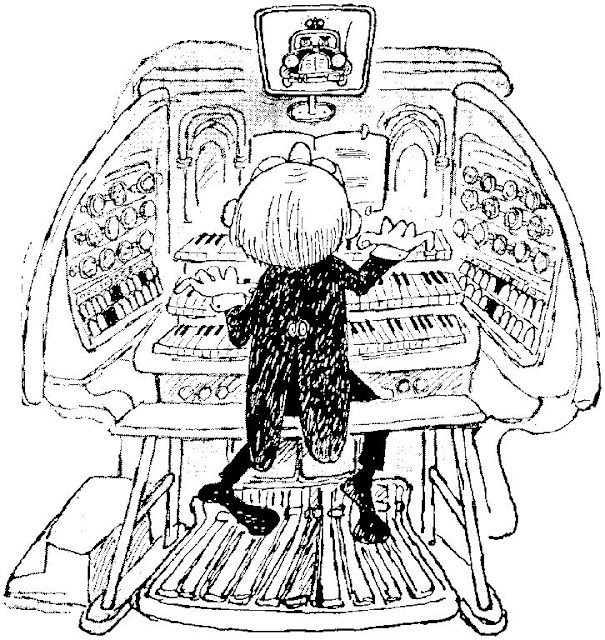
Westminster Abbey Organ | www.westminster-abbey.org The Catholic Church has long held the organ in high esteem as the premier musical instrument for use in the sacred liturgy. Several key reasons emerge from the provided references as to why the organ is valued in the Mass: The organ is "especially fitted for the sacred chants and sacred rites" and "adds a wonderful splendor and a special magnificence to the ceremonies of the Church." Its grand and majestic sound helps elevate the solemnity and grandeur of the liturgical celebration. The organ "moves the souls of the faithful by the grandeur and sweetness of its tones" and "gives minds an almost heavenly joy and it lifts them up powerfully to God and to higher things." The organ's music has the power to inspire devotion and draw the faithful closer to the divine. The organ's sound "enhances the whole liturgical ceremony with its noble art" and "adds dignity, majesty and a p...

Investing the Imagination

Image
But the ethos of the modern world is precisely synthetic and grounded in a false imitation. Ancient mimesis sought to emulate in the microcosmic world of man the “music of the spheres” and to align the human realm with the divine. But modern imitation is Titanistic insofar as it begins and ends with a repudiation of the normativity of the formal structures of existence and thus seeks to make everything plastic and fungible in the interests of “control and domination”. - Larry Chapp The Church has relied on vivid imaginations nurtured by a continuous recollection of prior explorations in art, architecture and music, bound to the will of the Chief Architect, the Holy Ghost, so that contemporary expressions may become part of the language of worship, to infuse the imagination with authentic desire for holiness and to lead souls to God. We live in times, however, when cheap imitations abound, and Catholics are all too happy, it seems, to endorse the plastic and trivial. Church official...

Pope Francis Tidbits on the Mass

Image
ADDRESS OF HIS HOLINESS POPE FRANCIS TO THE "SCHOLAE CANTORUM" OF THE ITALIAN ASSOCIATION OF SAINT CECILIA Beautiful and good music is a privileged tool for approaching the transcendent, and often helps to understand a message even those who are distracted. I know that your preparation involves sacrifice in terms of the availability of time to devote to rehearsals, to the involvement of people, to performances on feast days, when perhaps friends invite you to go for a walk. Many times! But your dedication to the liturgy and its music represents a way of evangelization at all levels, from children to adults. In fact, the liturgy is the first “teacher” of catechism. Do not forget this: the liturgy is the first “teacher” of catechism. Sacred music also carries out another task, that of bringing together Christian history: in the liturgy, Gregorian chant, polyphony, popular music and contemporary music resonate. It is as though, in that moment, there were all the past and present...

Kurek's Aesthetic Philosophy in a Nutshell

Image
MICHAEL KUREK, COMPOSER MY AESTHETIC PHILOSOPHY https://michaelkurek.com/ Excerpt We are on life’s journey and seem to be wired to desire a series of goals, even a spiritual purpose. Likewise, we are endlessly engaged by the elements of drama in a narrative: Exposition, Inciting incidents, Rising action, Climax, Falling action, and Resolution. Storytelling has always been, and will arguably always be, universal in all cultures. Conversely, music that sounds random, unpredictable, with little or no feeling of narrative or goal, for me, symbolizes aimlessness and purposelessness or even nihilism in life . However, I am not talking about doing a skillful forgery of Bach or Chopin, which would of course sound derivative. I am talking about the same process used by the great composers, an assimilation and synthesis of many influences to create a uniquely personal voice. I believe you do have to somehow tell your story in your own “uniquely personal voice,” that is, through your own eyes, ju...

Frivolity of Sorts

Image
Hilarity, or Hymnody S.J. Forrest (by way of Project Canterbury) Our church is mighty spikey with smells and bells and chants, And Palestrina masses that vex the Protestants. O happy ones and holy who fall upon their knees For solemn Benediction And mid-week Rosaries. Though with a scornful wonder men see our clergy, dressed In rich brocaded vestments as slowly they process; Yet saints their watch are keeping lest souls be set alight Not by the Holy Ghost, but by incense taking flight. Now we on earth have union with Lambeth, not with Rome, Although the wags and cynics may question our true home; But folk masses and bingo can't possibly depose The works of Byrd and Tallis, or Cranmer's stately prose. ( Here shall the organist modulate ) So let the organ thunder, sound fanfares "en chamade;" Rejoice! For we are treading where many saints have trod; Let peals ring from the spire, sing descants to high C, Just don't let your elation Disrupt the liturgy.

A Psalm of David

Image
Detail from The Garden of Earthly Delights by Heironymous Bosch   We in the Ordinariate are blessed with a wealth of great music - hymns, polyphony, chant - from both the pre-Reformation Catholic patrimony and the sacred music that continued to be developed and celebrated in the venerable Anglican patrimony. The wealth of the Anglican patrimony, its awe inspiring treasure trove of sacred music, is a treasure ready to be shared throughout the entire Catholic Church. One wonders why, when so many glorious compositions are available, people retain an almost addictive attachment to compositions that are to great works of art as junk food is to cuisine? A diet of spiritual junk food has a serious effect on the well being of a person. A diet of spiritual junk food robs the soul of "nutrients", the art through which God - the True, the Good and the Beautiful - offers the worshipper who reaches out to God for life, love, hope, mercy and forgiveness. Sure, God can and does reach peop...

Bye Bye Art. A meditation on the loss of art, on life oriented to the transcendentals, on the rise of violence, on the politics of fear and the loss of freedom.

Image
We've all noticed it. 'It' being the loss of live music, live theatre and dance. Choirs have become muted or made silent altogether. Symphony concerts are gone. Ballets and dance recitals have been crippled by physical distancing. When was the last time a theatrical production was due to open at a local theatre? Why is it that the arts are suppressed with expediency when a society loses its mind to fear? The arts are among the first things to be jettisoned when a society descends into its lowest mode of existence.  Need it be said that, during a time of great distress, the arts are exactly what human beings need in order to cope and maintain hope, to retain their sense of humanity? Deprive people of the opportunity to hear their stories shared and they forget soon enough who and what they are. Having no story, inventions creep in that exploit people's fears and render imaginations excitable about all the wrong kinds of fascinations. And, need it be said, that when music...

POPE LEO XIV Magnifica Humanitas

Even in the darkest nights, the Lord raises up men and women who refuse to give up, who persevere in doing good, who protect the vulnerable and open pathways to reconciliation. The memory of the saints, righteous people and the oft-forgotten peacemakers, show us that grace does not magically eliminate conflict, but instead it inspires active resistance to evil and an astonishing creativity in doing good” (paragraph 211).

WILLIAM SHAKESPEARE

I doubt not then but innocence shall make false accusation blush, and tyranny tremble at patience.

WORDS TO THE WHYS

You cannot subsidize irresponsibility and expect people to become more responsible. Thomas Sowell