Posts

Showing posts with the label Holy Trinity

WORDS TO THE WHYS

The truth will make you odd. Flannery O’Connor

Perichoresis: the Hidden Architecture of the Sacred Liturgy.

Image
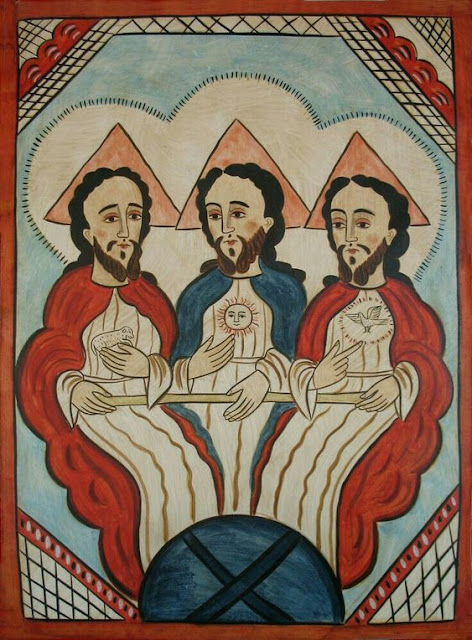
The doctrine of perichoresis—the mutual indwelling of the Father, Son, and Holy Spirit—quietly shapes every moment of the Catholic Mass. At its core, perichoresis expresses that each divine Person fully possesses the one divine nature while remaining truly distinct. This mystery of shared life becomes the hidden architecture of the liturgy, revealing that the Mass is not merely directed to God but is an entry into the eternal communion within God. The term perichoresis comes from the Greek words peri , meaning “around,” and chōreō , meaning “to make room” or “to move." Literally, it conveys the idea of “going around” or encompassing, suggesting a dynamic, reciprocal relationship. In Latin, the equivalent term is circumincession , derived from circum (“around”) and incedere (“to go, to step”). While sometimes poetically described as a “divine dance,” the core meaning emphasizes complete unity without confusion, where each Person of the Trinity fully indwells the others while remai...

The Holy Trinity At the Heart of Catholic Worship

Image
J15R The Holy Trinity stands at the heart of Catholic worship, and nowhere is this mystery more vividly enacted than in the sacred drama of the Mass. At its core, the Eucharistic liturgy is the Church’s participation in the eternal exchange of love among the Father, Son, and Holy Spirit—an exchange into which the faithful are drawn and transformed. Understanding the Mass through a Trinitarian lens reveals its deepest meaning: it is the Son offering Himself to the Father in the Spirit, and the Church joining that perfect act of praise. From the opening Sign of the Cross, the Mass situates the worshipper within the life of the Trinity. The gesture itself is a confession of faith in the Triune God, marking the body with the name of the Father, Son, and Holy Spirit. This is not a mere formula but an act of identity: the faithful declare that they belong to God’s inner life. The greeting (in the Ordinary Form) that follows—“The grace of our Lord Jesus Christ, the love of God, and the commu...

Seven Days A Week: Brief Meditations and Prayers

Image
Caritas Sunday Veritas Monday Bonitas Tuesday Pulchritudo Wednesday Sanctitas Thursday Unitas Friday Haereditas Saturday + + + Charity Sunday Resurrection Blessed are the poor in spirit, for theirs is the kingdom of heaven.  Blessed are the merciful, for they will be shown mercy. A heart of love offers the mercy of healing to others. Be ready to accept humiliations. They can hurt terribly but they can help to keep you humble. (Whether trivial or big, accept them). All these can be so many chances to be a little nearer to our Lord. There is nothing to fear if you are near to the Lord and in His Hands. Michael Ramsey, excerpt from  Five Helps for the New Year . Almighty Father, help us to be ever mindful of Thy gift of salvation in Christ Jesus, Thy Son, who died so that we might have life and love Thee for all eternity. May we abide in humility, that we be numbered amongst those within Thine everlasting Kingdom. Grant that we be ever merciful, welcoming others into Thine embrac...

Trinitytide And A 13th Century Trinitarian Hymn

Image
The period of Ordinary Time from Pentecost until Advent in the calendar that is followed by the majority of Latin Rite Catholics, i.e., those who follow the calendar for the Novus Ordo Mass of Pope Saint Paul VI, is referred to as Trinitytide in the Personal Ordinariates . It is the longest season of the Church year. Anglo-Saxon churches and parts of northern Europe celebrated a feast of the Trinity as early as the 9th century. Saint Thomas Becket (1119 or 1120–1170), who was made bishop on the Sunday following Pentecost, is known to have celebrated the feast of the Holy Trinity at Canterbury. In 1334, Pope John XXII instituted the Feast of the Holy Trinity for the entire Church on the first Sunday after Pentecost. Trinitytide begins on the Sunday following Whitsuntide (the Octave of Pentecost). Trinitytide is a time of hope-filled Christian discipleship that arises from living in communion with the Holy Trinity. The Holy Trinity is central to authentic Christian mission. When Jesus se...

Christian Holiness | Deification and the Holy Trinity

Image
2 Peter 1:3-4 |  His divine power has granted to us all things that pertain to life and godliness, through the knowledge of him who called us to his own glory and excellence, by which he has granted to us his precious and very great promises, that through these you may escape from the corruption that is in the world because of passion, and become partakers of the divine nature. Deification, also known as theosis or divinization, is the process of becoming united with God, sharing in His divine life, and experiencing His eternal happiness. This concept is deeply intertwined with the doctrine of the Trinity, as it is through the Father, Son, and Holy Spirit that humanity is called to share in God's own life. The Scandal of the Incarnation: Irenaeus Against the Heresies, Selected and Introduced by Hans Urs von Balthasar, trans. John Saward  (1981), pp 54 & 55. | There was no other way for us to receive incorruptibility and immortality than to be united to incorruptibility an...

In the mystery of the Unity and Trinity of God we believe that... . By Fr. Z.

Image
2017 post by Fr. John Zuhlsdorf o{]:¬) [ RCM LINK ] formatted by Gilbert 2025 A brilliant composition by Father Zuhlsdorf as we approach the august mystery of the Holy Trinity held in the Ordinariate as Trinitytide (Ordinary Time) following Whitsuntide (the season of Pentecost). + + + In the mystery of the Unity and Trinity of God we believe that, from all eternity and before material creation and even outside of time itself, the One God who desired a perfect communion of love expressed Himself in a perfect Word, containing all that He is.  The Word God uttered was and is a perfect self-expression, also perfectly possessing what the Speaker possesses: being, omniscience, omnipotence, truth, beauty, and even personhood. So, from all eternity there were always two divine Persons, the God who spoke and the Word who was spoken, the God who Generates and the God who is Generated, true God with and from true God, Begetter and Begotten, Father and Son. There was never a time when this was...

Trinitytidings

Image
  The Trinity is a communio personarum , a “communion of persons.” In God, the problem of unity and diversity is overcome in a way man will never achieve: one Godhead, yet three Persons. Amid all the sophisticated distinctions of Trinitarian and Christological theology, the mystery of “begettings” and “processions” can be summarized in a few words: God loves. God loves with the fullness of his Being. And because love necessarily involves another, God’s love gives life: the Father gives life to the Son, who is as truly and eternally and perfectly God as the Father. And the Son, the object of the Father’s love, loves eternally, so that where their loves join proceeds the Spirit, who proceeds from the love of “the Father and the Son.” - John Grondelski So there is One Father, not Three Fathers; one Son, not Three Sons; One Holy Ghost, not Three Holy Ghosts. And in this Trinity none is afore or after Other, None is greater or less than Another, but the whole Three Persons are Co-eterna...

Quotes for a Monday in Trinitytide

Image
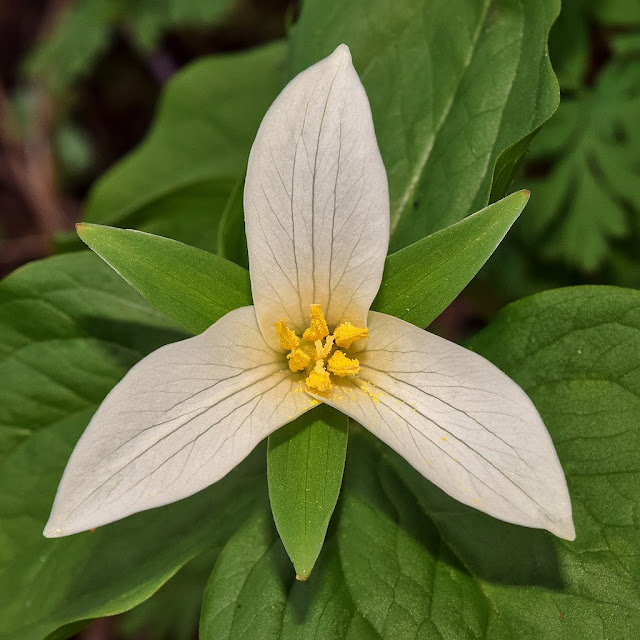
Trillium ovatum | Pacific or Western Trillium The Trinity is the answer to the questions of Plato. If there is only one God, what does He think about? He thinks an eternal thought: His eternal Word, or Son. If there is only one God, whom does he love? He loves His Son, and that mutual love is the Holy Spirit. The great philosopher was fumbling about for the mystery of the Trinity, for his noble mind seemed in some small way to suspect that an infinite being must have relations of thought and love. But it was not until the Word became Incarnate that man knew the secret of those relations and the inner life of God, for it was Jesus Christ, the Son of God, Who revealed to us the inmost life of God. - Ven. Fulton J. Sheen, Three to Get Married The "name" of the Most Holy Trinity is in a certain way impressed upon everything that exists, because everything that exists, down to the least particle, is a being in relation, and thus God-relation shines forth, ultimately creative Love ...

Trinity Tidal Wave

Image
No doubt many of you have read Fr. Zuhlsdorf's essay on the Holy Trinity. Well, here it is again. Read the explanation here at this blog, formatted by yours truly: https://atreasuretobeshared.blogspot.com/p/the-mystery-of-unity-and-trinity-of-god.html Fr. John Zuhlsdorf explains the Holy Trinity Beautifully by Fr Richard Heilman https://www.romancatholicman.com/fr-john-zuhlsdorf-explains-holy-trinity-beautifully/ June 10, 2017 I don’t know what I did to deserve having one of the great minds of the Church serving alongside of me, but I praise and thank God everyday for this wonderful gift. I am speaking about Fr. John Zuhlsdorf (Fr. Z). If you are not reading his blog every day, you are missing out on amazing treasures of our faith, mixed in with a rich sense of humor. I read his blog for most of the years he has used it for his incredible teachings, but we became acquainted once he became aware of some of the bricks I was laying in the “brick by brick” process of restoring the litu...

"The transcendent distance between God and man."

Image
An excerpt from an article by David Fagerberg, Ph.D. https://www.catholicworldreport.com/2020/04/16/on-doctrinal-development-and-a-western-appreciation-of-eastern-christianity/ (3) An apophatic emphasis. Do not begin any theological enterprise without confessing the transcendent distance between God and man. God is beyond knowing. Augustine’s Latin phrase would satisfy any Eastern theologian: si comprehendis, non est deus – if you comprehend it, it is not God. The creature cannot know the Creator, and yet the Creator has made himself knowable, describable, circumscribable. God has done so first through revelation in the cosmos (where tracks of the Logos are imprinted as the creature’s logoi ), second through revelation in Scripture (which Ephrem the Syrian said is the “first incarnation” because God clothed himself in our metaphors), and third through revelation in person, whom the Holy Spirit continues to make present in the mystical body of the Church. The gol...

POPE LEO XIV Magnifica Humanitas

Even in the darkest nights, the Lord raises up men and women who refuse to give up, who persevere in doing good, who protect the vulnerable and open pathways to reconciliation. The memory of the saints, righteous people and the oft-forgotten peacemakers, show us that grace does not magically eliminate conflict, but instead it inspires active resistance to evil and an astonishing creativity in doing good” (paragraph 211).

WILLIAM SHAKESPEARE

I doubt not then but innocence shall make false accusation blush, and tyranny tremble at patience.