Posts

Showing posts with the label God

The Voice of God In Holy Scripture

Image
The voice of God in Holy Scripture is never a mere sound; it is the living self‑communication of the Lord who speaks to His people in order to create, judge, redeem, and sanctify. Across the canon, God’s voice is portrayed as both transcendent and intimate—majestic in power yet directed personally to the human heart. The Voice that Creates and Commands From the opening lines of Genesis, God’s voice is the medium of creation: “And God said…” (Gen 1). Divine speech is performative; it brings reality into being. Scripture thus presents the world not as a random emergence but as the ordered result of God’s articulate will. The same creative voice later gives the Law at Sinai (Exod 19–20), revealing that the One who speaks worlds into existence also speaks covenantal commands that shape human life. The Voice that Reveals and Interprets The prophets repeatedly describe their vocation as hearing and transmitting the word of the LORD (Jer 1:4–10; Isa 6). God’s voice is revelatory: it discloses...

Psychophysical Harmony As A Sign Of God's Design

Image
One of the more intriguing developments in recent philosophy of religion, and the topic of more than a few online commentators, is the “psychophysical harmony” argument advanced by Brian Cutter and Dustin Crummett of Notre Dame University, Indiana. It is a design‑style argument, but not of the familiar biological or cosmological sort. Instead, it turns our attention inward—toward the structure of conscious experience itself—and asks why our phenomenal lives fit so uncannily well with the physical and behavioral lives we lead. The phenomenal realm and the physical-behavioral realm. Human beings inhabit two domains at once. There is 1) the phenomenal realm: what pain feels like, what hunger feels like, what the color red looks like, what fear or joy or longing is “from the inside.” And there is 2) the physical-behavioral realm: the bodily motions, neural firings, and environmental interactions that make up our lives as organisms. In our world the two realms are exquisitely aligned. Pain ...

The Lord in The Liturgy: The Formation Of Intentional And Resilient Christians

Image
The Ordinariate’s Liturgy Shapes the Soul Through Beauty, Order, and Sacramental Realism Divine Worship, the liturgical expression entrusted to the Ordinariates, is far more than a beautiful way of praying. It is a formative environment — a spiritual architecture that shapes the worshipper’s imagination, posture, and self‑understanding. In a culture marked by distraction, fragility, and self‑invention, Divine Worship quietly trains the believer to stand firm, to speak truthfully, and to live faithfully. Its beauty is not ornamental; its order is not rigid; its language is not nostalgic. All of it works together to cultivate resilience and responsibility as lived habits of Christian maturity. The Gravity That Strengthens the Soul One of the most striking features of Divine Worship is its gravity. The Liturgy carries a seriousness that is neither severe nor distant, but deeply dignified. The worshipper is confronted with the reality that he stands before the living God. The Collects, the...

A Prayer For Those Abandoned

Image
Heavenly Father, gracious and compassionate Lord, we humbly implore Thee to bestow upon those distraught the grace to endure, the strength to face each day with renewed awareness of Thy boundless love and the support of friends, the courage to overcome trials, and hearts filled with forgiveness. Grant serenity to those who feel abandoned, that they may be united with Thee in prayer and find the freedom of Thy abiding Presence to sustain them in hope and in Thy peace; through Jesus Christ, Thy Son, our Lord, who liveth and reigneth with Thee, in the unity of the Holy Spirit, ever one God, world without end. Amen.

God's Right To Our Worship

Image
Revelation 4:11 |  Worthy art thou, our Lord and God, to receive glory and honor and power, for thou didst create all things, and by thy will they existed and were created. Why do we worship God? In a day and age when people seem perfectly content, even rabidly so, to worship themselves (and things less themselves) in an attempt to maximize control over their own lives and those of others, the question hardly seems relevant when people are so fixated on fleeting matters. Let's look at a couple of authors who dig into the issue of worship to enrich our understanding so as to be proactive in our daily journey, so that we might be better prepared to meet the temptations that may distract us from the One Who rescues us from darkness and Who offers us His very life. Excerpt from  The Theo-Centric Character of Catholic Liturgy by Raymond Leo Card. Burke. The Thomistic Institute, Pontifical Faculty of the Immaculate Conception, Dominican House of Studies, Thomistic Circle: “St....

Can Rock Concerts Be Worship? One Ordinariate Catholic's Perspective

Image
(CNS photo/Vatican Media) Lights, smoke, an elevated platform, guitars, drums, keyboards, and a large crowd facing the performers. A religious service or a rock concert? Candles, incense (... maybe), an elevated platform, guitars, drums, keyboards, and a large congregation facing the clergy. Same question. 'Praise and worship' is a label borrowed from evangelical and charismatic Protestant lexicons. The Catholic understands that God desires to be worshipped and praised in the Divine Liturgy. In the Mass, the Catholic can say, "I was gathered into the offering of the Son to the Father. I participated in the self-offering of God today." God has revealed to us how He wants to be worshipped. Jesus established the model for Catholic worship (St. Matthew 26:17-30). The Latin Rite liturgy has expanded or contracted over the centuries. Universal adjustments were modest until the Bugnini Concilium (1964 - 1969) instituted considerable revisions. A later council of ten faithful...

Art Not Art: autobiographies in paint and stone.

Image
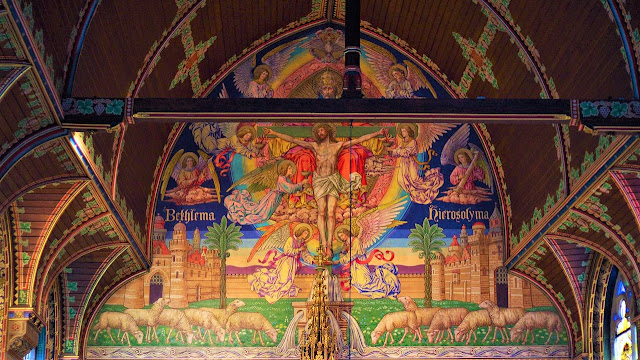
Basilica of the Holy Blood in Bruges, The Trinity, fresco above the high altar | René de Cramer Wikipedia H/T David Clayton The true work of art is but a shadow of the divine perfection. - Michelangelo Gart is the term that a former philosophy professor of mine imparted to us students to describe something pretending to be art. Technically speaking, there is no such thing as bad art. Art, by definition, describes something - is something - that belongs in the category of excellence and the sublime. Art epitomizes the best of something. Art embodies the true, the good and the beautiful. Gart, on the other hand, is something less than art. A determination of artistic merit does not depend on the popularity of a thing. Artistic merit is determined by the degree to which something epitomizes the true, the good and the beautiful. Merit can be intuited and/or deduced. One does not necessarily need a university degree to be able to recognize art. A trained intellect corrupted by attachmen...

God, Grace and His Goodness

Image
For Thomas, God is not the supreme being ( ens summum in his Latin), but rather ipsum esse subsistens , which means “the sheer act of to be itself.” In a word, God is not one more instance of the genus “being,” one thing, however exalted, among others; instead, he is the self-explaining source of existence as such, that great font of being in and through which all finite things subsist and act. Therefore, God does not compete for space, so to speak, on the same ontological grid as creatures; a zero-sum game does not obtain in regard to God’s activity and creaturely activity—the more we ascribe to one, the less we have to ascribe to the other. - Bishop Robert Barron If only mortals would learn how great it is to possess divine grace, how beautiful, how noble, how precious. How many riches it hides within itself, how many joys and delights! No one would complain about his cross or about troubles that may happen to him, if he would come to know the scales on which they are weighed when ...

POPE LEO XIV Magnifica Humanitas

Even in the darkest nights, the Lord raises up men and women who refuse to give up, who persevere in doing good, who protect the vulnerable and open pathways to reconciliation. The memory of the saints, righteous people and the oft-forgotten peacemakers, show us that grace does not magically eliminate conflict, but instead it inspires active resistance to evil and an astonishing creativity in doing good” (paragraph 211).

WORDS TO THE WHYS

The most fundamental fact about the ideas of the political left is that they do not work. Therefore we should not be surprised to find the left concentrated in institutions where ideas do not have to work in order to survive. Thomas Sowell

WILLIAM SHAKESPEARE

I doubt not then but innocence shall make false accusation blush, and tyranny tremble at patience.

EPICTETUS

If someone speaks badly of you, do not defend yourself against the accusations, but reply, "You obviously don't know about my other vices, otherwise you would have mentioned these as well."