Posts

WORDS TO THE WHYS

The stronger the claim, the calmer the voice.

Origins Of Mothering Sunday | Laetare

Image
Simnel Cake | BBC image - from the NEWS Notes of SJHN Victoria, BC Grant, we beseech thee, Almighty God: that we, who for our evil deeds do worthily deserve to be punished, by the comfort of thy grace, may mercifully be relieved; through Jesus Christ thy Son our Lord, who liveth and reigneth with thee, in the unity of the Holy Ghost, ever one God, world without end. Amen. - Collect for Mothering Sunday, Divine Worship: The Missal. Mothering Sunday falls every year on the Fourth Sunday in Lent, also called Mid-Lent Sunday or Refreshment Sunday, referring to its sense of respite halfway through this season of fasting and penitence. Medieval traditions surrounding this Sunday ranged from the practice of daughters visiting their mothers – especially important for those engaged as domestic servants away from home – to the gifts of simnel cakes or wafer cakes. These various customs came from the medieval recognition of this day as ‘Lætare Sunday’. In the Middle Ages, many Sundays were refe...

Say 'No' To Say 'Yes' To... . | A Brief Defense Of Holy Things

Image
Say 'no' to communion in the hand... to say 'yes' to the profound adoration of God by receiving the Holy Eucharist on the tongue. I mention, for example, a change not proposed by the Council Fathers or by the Sacrosanctum Concilium, Holy Communion received in the hand. This has contributed to some extent to a weakening of faith in the real presence of Christ in the Eucharist. This, and the removal of altar rails and kneelers in church and the introduction of practices which oblige the faithful to sit or stand at the elevation of the Sacred Host, weakens the genuine significance of the Eucharist and the Church’s profound sense of adoration for the Lord, the Only Son of God. Albert Malcolm Cardinal Ranjith (November, 2007) | Behind communion-in-the-hand – I wish to repeat and make as plain as I can – is a weakening, a conscious, a deliberate weakening of faith in the Real Presence.  Father John Hardon, S.J., November, 1997 |  One receives in the mouth what one believes ...

The Words We Speak. The Language Of The Ordinariate Mass.

Image
A series of excerpts from articles on hieratic sacral English. hieratic (adj.) "pertaining to sacred things," 1660s, from Latin hieraticus , from Greek hieratikos "pertaining to a priest or his office, priestly, devoted to sacred purposes," from hierateia "priesthood," from hiereus "priest," from hieros "sacred, holy, hallowed; superhuman, mighty; divine". "Sacred English" is a variation of English that was developed especially for use in religious settings. Remember the language from the King James and Douay-Rheims Bibles and previous versions of the Book of Common Prayer. It is not necessary to constantly remind the reader who is speaking to whom when using sacral English. Every sentence in the language does this. Both ancient and contemporary languages are used for this. Unfortunately, common English is not one of them. This is the reason it is called "Sacral English": religious writings and prayers, particularly ...

Whose View? The Lenses Employed.

Image
The Dispute of Saint Catherine of Alexandria  | Francisco Ribalta People perceive the world through various lenses. It may be a lens of their choosing, or perhaps a lens that has chosen them. In the latter case, individuals might be navigating life by adopting a lens that offers the least resistance or the simplest path they've discovered, without explicitly acknowledging its existence. Of the former, the lens may be trained or focused in a way that constrains understanding into a narrow ideological perspective that creates blind spots, or the lens—being a true lens that does not filter the information—may open the viewer to a much wider and more honest view of reality. When viewed through a foggy lens, Human sexuality appears fluid and chaotic. The mind is ruled by the senses and seduced into submission to the material. The mind becomes addicted to solutions of a mechanical and materialistic kind and, ironically, the person becomes addicted to self medicating himself. When one ...

Ordinariate Prayer for the Jubilee Year 2025

Image
O BLESSED Virgin Mary, Mother of God and our most gentle Queen and Mother, look down in mercy upon us, our families, our Parish and Ordinariate, and upon all who greatly hope and trust in thy prayers, as we implore thine aid and intercession in this Jubilee year. By thee it was that Jesus, our Savior and hope, was given to the world; and he has given thee to us that we may hope still more. O gracious Mother, plead for us thy children, whom thou didst receive and accept at the foot of the Cross when thou received the Beloved Disciple into thine embrace. Intercede too for our separated brethren, that with us in the one true fold they may be united to the Chief Shepherd, the Vicar of thy Son. Pray for us all, dear Mother, that our hearts may be filled with holy hope, and that we may never fail to trust in God our Saviour, but by walking in the way of His commandments we may merit to be united with Him, and with thee in the eternal charity of Heaven.  Amen. Our Lady of Walsingham, pray...

Ash Wednesday | A Penitential Office for the Blessing of Ashes

Image
A PENITENTIAL OFFICE for the BLESSING of ASHES that precedes Divine Worship, the Venerable English Mass of the Ordinariate. EXADUI NOS Psalm 69.17, 1 HEAR me, O Lord, for thy loving-kindness is comfortable: turn thee unto me according to the multitude of thy mercies. Ps. Save me, O God, for the waters are come in even unto my soul. (Bow) Glory be… (Upright) As it was...   Hear me… The Celebrant now turns to the people and says: BRETHREN, it has been the custom in the Church from ancient times to observe with great devotion the days of our Lord’s Passion and Resurrection, and to prepare for the same by a season of penitence and fasting. This season of Lent provided also a time in which converts to the faith were prepared for holy Baptism. It was also a time when such persons as had, by reason of notorious sins, been separated from the body of the faithful, were reconciled and restored to the fellowship of the Church by penitence and forgiveness. Thereby the whole Church was...

Divine Worship | Form One of The Offertory

Image
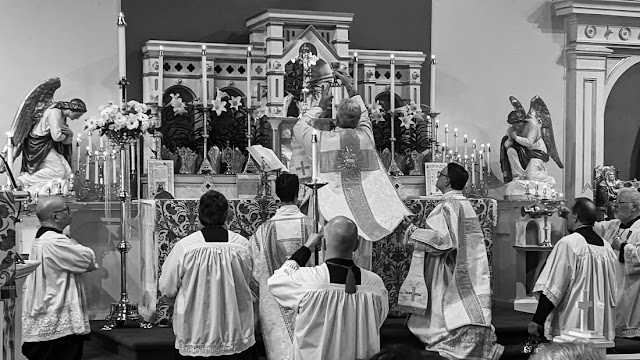
Divine Worship: the Missal, the Missal of the Personal Ordinariates, retains the older set of offertory prayers (in the vernacular) and also includes in a separate section the shorter offertory prayers (Form II) found in the Novus Ordo Missal of Pope Saint Paul VI. The longer offertory prayers capture the sacrificial nature of the Mass. Our sacrifice - offerings of bread and wine that represent us - our hopes, our needs, our lives - is joined to the prayer of Jesus to the Father in the Holy Spirit. The bread and wine are accepted by Jesus and become by the power of the Holy Ghost the very Body, Blood, Soul and Divinity of Jesus Christ. See article :  https://www.catholic.com/magazine/print-edition/transubstantiation-for-beginners The one sacrifice of Christ on Calvary is made present in every valid Mass. Time and eternity meet. The congregation becomes present to the banquet of Jesus and the Apostles when Jesus established the Sacrament of the Eucharist and the Sacrament of Holy Or...

The Venerable English Mass of the Ordinariate: Renewal And Continuity

Image
[Read time 3 minutes] The Venerable English Mass, Divine Worship, is the legitimate offspring of a conversation between continuity and reform that (re-)unites the Anglican Patrimony—that is, the Catholic Patrimony preserved in Anglicanism—with the Church. Divine Worship is more than a collection of liturgical texts and ritual gestures. It is the organic expression of the Church’s own lex orandi as it was taken up and developed in an Anglican context over the course of nearly five-hundred years of ecclesial separation, and is now reintegrated into Catholic worship as the authoritative expression of a noble patrimony to be shared with the whole Church. As such, it is to be understood as a distinct form of the Roman Rite. Further, while Divine Worship preserves some external elements more often associated with the Extraordinary Form, its theological and rubrical context is clearly the Ordinary Form of the Roman Rite. That I situate Divine Worship within the context of the Ordinary Form b...

Sexagesima

Image
From St Aelred Catholic Church (OCSP)/edited. Sexagesima, which translates from Latin as "sixtieth," is the eighth Sunday before Easter and the second Sunday before Lent. It holds a significant place in the liturgical calendar as it marks a preparatory phase leading into the Lenten season. The name "Sexagesima" is derived from its position in the countdown to Easter, although it does not literally represent the sixtieth day before Easter. Instead, it is part of a numerical series that includes Septuagesima (the ninth Sunday before Easter) and Quadragesima (the fortieth day, or Lent). This Sunday has been recognized since at least the Fourth Council of Orléans in 541. The observance of Sexagesima is particularly important as it transitions the faithful from the festive nature of the Epiphany season into a more somber and reflective period. The Pre-Lenten season is from the Medieval era and existed until it was removed from the Roman Rite Calendar in 1970 after Vatica...

Does Your Parish Mass Resemble Frankenstein's Monster?

Image
Heaven On Earth [ 7 minute read ] The haphazard way in which many (most?) diocesan Eucharistic liturgies, i.e., Masses, are celebrated points to an enduring problem: poor catechesis and an obstinate refusal to respect the fundamental nature of the Holy Eucharist. It may be that ignorance about liturgical standards factors into the problem, and that could explain why improvements to the ars celebrandi , i.e., the manner in which the Mass is celebrated, are long overdue throughout the entire Church. That is, the Latin hemisphere of the Church. The Holy Eucharist is defined as the sacrament that contains the Body and Blood, Soul and Divinity of our Lord Jesus Christ under the appearances of bread and wine. | A Catechism of Christian Doctrine (The Baltimore Catechism No. 3); Third Plenary Council of Baltimore 1954 AD Surely the preceding note is enough to inspire respect for the Liturgy and to encourage beautiful celebrations of the Mass by clergy and servers. The fundamental character of ...

POPE LEO XIV Magnifica Humanitas

Even in the darkest nights, the Lord raises up men and women who refuse to give up, who persevere in doing good, who protect the vulnerable and open pathways to reconciliation. The memory of the saints, righteous people and the oft-forgotten peacemakers, show us that grace does not magically eliminate conflict, but instead it inspires active resistance to evil and an astonishing creativity in doing good (paragraph 211).

MARCUS AURELIUS

The opinion of 10,000 men is of no value if none of them know anything about the subject.

WILLIAM SHAKESPEARE

I doubt not then but innocence shall make false accusation blush, and tyranny tremble at patience.