Life In The Confession Line
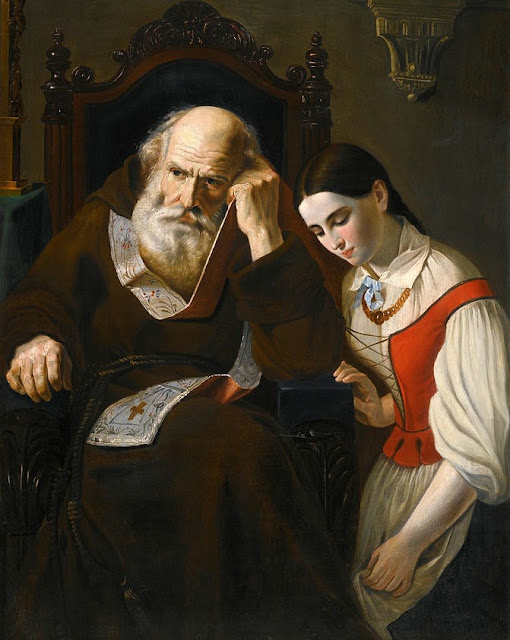
- The Terpsichorean: can't sit still in the pew; shifts from being seated to kneeling to standing every couple of minutes.
- The Artful Dozer: half-asleep, leans against the wall or a neighbour; needs an occasional 'psst' to prompt him along.
- Mr. Fidget: weak bladder.
- The Chatterbox: attempts to engage others in small talk. You can almost bet she's gonna confess to gossipping.
- The Judge: whose penetrating gaze could cause a saint to wilt with guilt.
- The Timekeeper (aka The Tracker): her eyes are constantly on her watch timing each penitent in the box. Probably worked the clock during high school basketball games.
- The Narrator: rehearses his examination of conscience out loud.
- Mr. Scruples: you can practically see the sweat draining off his forehead.
- The Devotionalist: rigorously works the rosary beads, and whose whispering of prayers is almost as annoying as an ASMR (autonomous sensory meridian response) video of someone slurping hot soup.
- The Revert: hasn't been to confession in a decade and needs reassurance that the priest isn't hard of hearing and won't shout back his sins.
- The Page Flipperer: Who knew a penance book or devotional booklet could sound like a deck of cards being shuffled?
- The Leap Frogger: aka, the Queue Jumper; elicits looks of strong disapproval from others.
- The Saint: the curtains are drawn (veil), the head is bowed, hands are held palms together at the breast, and she is wearing more sacramentals than you can count. You had better hope that she isn't ahead of you because anything you say will be fifty times worse than anything that she confesses.
- The Phonerer: is constantly on her phone, on social media, takes selfies while waiting, and is constantly primping herself (...to what end is anyone's guess... and, frankly, who cares?).
- The Pilgrim: waits in line on his knees, and shuffles along... on his knees (see #13).
Popular Posts

One of the challenges facing many contemporary democracies is the increasing polarization of political life. When public debate becomes dominated by ideological camps that view one another with suspicion or hostility, society loses the capacity for reasoned dialogue and compromise. Citizens are encouraged to choose sides rather than seek truth, and opponents are too often treated as enemies rather than fellow participants in a common political community. Polarized politics can serve society insofar as it highlights important disagreements and brings competing values into public discussion. Vigorous debate is a normal and healthy feature of a free society. However, polarization serves the common good only partially when it hardens into tribalism, reducing complex issues to simplistic slogans and discouraging genuine understanding. A healthier society requires the classical liberal commitment to open inquiry and freedom of expression alongside the conservative appreciation for social coh...
One of the quiet strengths of Divine Worship, the Mass of the Ordinariates, is precisely its preservation of a kind of liturgical literacy through gesture. Many contemporary Christians can read words on a page, but fewer can "read" the language of worship enacted by the body. The Ordinariate tradition tends to retain a richer grammar of bodily signs than is commonly encountered in many parishes. By "literacy with gestures" is meant the ability of the faithful to recognize and understand actions such as: making the sign of the cross in acknowledgement and adoration at particular moments, e.g., as the Body of Christ is elevated and when the Precious Blood (chalice) is elevated bowing at the Holy Name of Jesus bowing in reverence toward the cross (the sign of our salvation) and priest (who acts in the person of Christ, in persona Christi ) as the procession passes striking the breast in humility during the Confiteor, Agnus Dei, and the Domine, non sum dignus genuflect...

St John the Evangelist Church, Calgary AB The saying, “Without the Holy Sacrifice of the Mass, the clergy are merely bureaucrats,” is intentionally provocative, but it expresses an important truth about the nature of the Church and the priesthood. At its heart lies the conviction that the Church is not fundamentally an institution of administration, but a sacramental communion whose life flows from the Eucharistic sacrifice. The priest certainly has many responsibilities beyond the altar. He teaches the faith, preaches the Gospel, cares for souls, comforts the suffering, and guides the Christian community. These are not bureaucratic tasks but genuine expressions of pastoral and spiritual fatherhood. Yet all of these ministries find their deepest meaning in their relationship to the Eucharist, which the Church calls the source and summit of the Christian life (CCC 1324). When the Mass is forgotten or marginalized, the remaining administrative duties of the clergy can easily come to domi...

Screenshot | Artistic impression of Medieval Priory built beside the Holy House (Denny) The Foundation of the Chapel of Walsingham The Pynson Ballad, published by Richard Pynson circa A.D. 1485* https://www.walsinghamanglicanmedieval.org.uk/pynson.htm https://web.archive.org/web/20080725010750/http://www.walsinghamanglicanarchives.org.uk/pynsonballad.htm http://devotiontoourlady.com/shrine-of-walsingham.html Of this chapell se here the fundacyon, Bylded the yere of crystes incarnacyon, A thousande complete syxty and one, The tyme of sent Edward kyng of this region. Beholde and se, ye goostly folkes all, Which to this place have devocyon When ye to Our Lady askynge socoure call Desyrynge here hir helpe in your trybulacyon: Of this hir chapell ye may se the fundacyon. If ye wyll this table overse and rede Howe by myracle it was founded indede. A noble wydowe, somtyme lady of this towne, Called Rychold, in lyvynge full vertuous, Desyred of Oure Lady a petycyowne Hir to honoure with some w...

The Christian life is fundamentally a participation in the light of Christ. Throughout Sacred Scripture, light symbolizes truth, holiness, and communion with God, while darkness signifies sin, error, and separation from Him. Because Christ is the Light of the World, those who follow Him cannot persist in a lifestyle of sin without contradicting their identity as His disciples. Jesus declared, “I am the light of the world; he who follows me will not walk in darkness, but will have the light of life” (John 8:12). This statement presents not merely a comforting promise but a moral challenge. To follow Christ is to leave behind the darkness of sin and to walk in the illumination of divine grace. Just as physical light dispels darkness, the presence of Christ transforms the soul and calls believers to conversion. St. John develops this theme even more strongly: “God is light and in him is no darkness at all” (1 John 1:5). He continues by warning that anyone who claims fellowship with God wh...
Yes to Virtue; No to Sin The history of salvation is the drama of two opposing kingdoms: the Kingdom of God and the kingdom of darkness. Every soul must choose between them. There is no neutrality in the spiritual life. Our Lord Jesus Christ calls His disciples to reject sin and pursue holiness, declaring, "No man can serve two masters" (Matt. 6:24). The Christian life is therefore a continual and deliberate "yes" to virtue and a steadfast "no" to sin. Virtue is the beauty of a soul conformed to God. It is not merely the performance of isolated good actions but a stable disposition to choose the good with readiness and joy. The Catechism of the Catholic Church defines virtue as "a habitual and firm disposition to do the good."¹ St. Thomas Aquinas teaches that virtue perfects the powers of the soul, enabling man to act according to right reason illumined by grace.² Through the theological virtues of faith, hope, and charity, the Christian particip...
POPE LEO XIV Magnifica Humanitas
Even in the darkest nights, the Lord raises up men and women who refuse to give up, who persevere in doing good, who protect the vulnerable and open pathways to reconciliation. The memory of the saints, righteous people and the oft-forgotten peacemakers, show us that grace does not magically eliminate conflict, but instead it inspires active resistance to evil and an astonishing creativity in doing good (paragraph 211).
WILLIAM SHAKESPEARE
I doubt not then but innocence shall make false accusation blush, and tyranny tremble at patience.
SENECA
Nothing is more honorable than a grateful heart.
WORDS TO THE WHYS
Rhetoric is no substitute for reality. Thomas Sowell


Comments
Post a Comment
Your comments will be appreciated and posted if 1) they are on topic and 2) preserve decorum.
Stand by your word.