The Composite Order: Part I - The Triumph of Christ.
Christus vincit! Christus regnat! Christus imperat!
The Composite Order refers to an order of design in architecture, a synthesis that unites the Ionic and Corinthian orders.
Denis Robert McNamara, in his book Catholic Church Architecture and the Spirit of the Liturgy, describes the character of superiority that the Composite Order embodies. McNamara writes that one finds among the various structures of the original St. Peter's Basilica the "symbol of a new kind of victory". I.e., the Composite Order. The Composite Order, the highest order, represents the triumph of Christ over the world.
What do the Ionic, Corinthian and Composite orders look like? Consider the last three capitals on the right below, respectively the Ionic, the Corinthian and lastly, farthest to the right, the Composite.
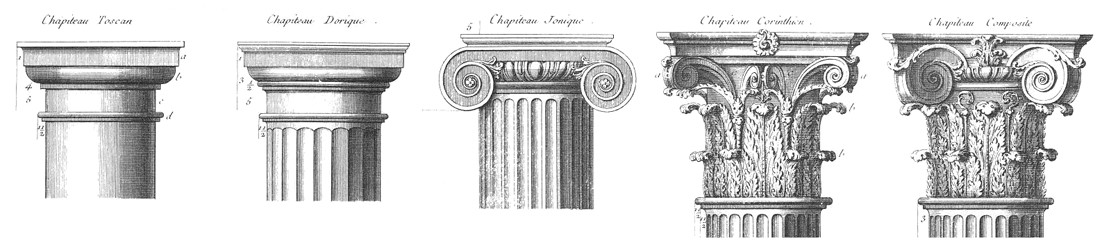
The Composite Order
 |
| Image found at Quadralectic Architecture |
In the Composite Order, the lavish acanthus leaves are retained from the Corinthian Order. The strong volutes (scrolls) are retained from the Ionic Order. The volutes of the Composite Order are, typically, larger than the scrolls of the Corinthian Order.
The Acanthus plant is a hardy shrub with excellent adaptation skills. Its various forms are known for their curative properties. Acanthus Ilicifolius, for example, has been used to treat rheumatoid arthritis, asthma, diabetes, leprosy, hepatitis and snake bites.

The principle underlying the Ionic scroll is the Fibonacci series, a mathematical progression seen in natural growth. For example, in: rams horns; nautilus shells; artichokes; sunflowers; pine cones; fiddleheads; etc. There is good reason, too, why violins, violas and violoncellos are topped with a scroll.
Overall, the Composite Order displays sumptuous decoration that reflects a sense of triumph and grandeur. Historically, Composite columns were utilized to represent victory, and they seemingly represent the blending of wisdom with beauty. As so, Composite columns are best utilized for projects that call for supreme opulence, prestige, and success.—Chadsworth Incorporated
Might we entertain, for a moment, the notion that the Ordinariate liturgy, Divine Worship, like the Composite Order, achieves a timely synthesis that declares the triumph of Christ?
Let us propose that the Ordinariate Mass honours and carries forward the "volutes" of one form and the "acanthus leaves" of the other. Carrying forward the Mass to meet the needs of souls is precisely what Trent did for a then new chapter in history by promulgating the Missal of Pope Saint Pius V. The 1965/66 Missale Romanum, and later the 1969 Novus Ordo Missae (now known as the Ordinary Form of the Mass)—i.e., the Missal of Blessed Paul VI, constructed by the Bugnini Consilium—attempted to move the Mass in a direction whereby men could better access the spiritual goods of the Sacred Liturgy.
Let us propose that the Ordinariate Mass honours and carries forward the "volutes" of one form and the "acanthus leaves" of the other. Carrying forward the Mass to meet the needs of souls is precisely what Trent did for a then new chapter in history by promulgating the Missal of Pope Saint Pius V. The 1965/66 Missale Romanum, and later the 1969 Novus Ordo Missae (now known as the Ordinary Form of the Mass)—i.e., the Missal of Blessed Paul VI, constructed by the Bugnini Consilium—attempted to move the Mass in a direction whereby men could better access the spiritual goods of the Sacred Liturgy.
Sacrosanctum Concilium, Introduction: 4—The (Second Vatican) Council also desires that, where necessary, the rites be revised carefully in the light of sound tradition, and that they be given new vigor to meet the circumstances and needs of modern times.
Of course, the Tridentine reform was quite modest in most respects. There could be a lengthy discussion about whether or not the modifications called for by the Second Vatican Council were accurately applied. A discussion for a different blog site.
For English speakers, Divine Worship decisively reorients the trajectory of liturgical renewal in a direction most pleasing to/for anyone who appreciates the True, the Good and the Beautiful. That is, through those transcendentals the worshipper is pointed toward and drawn by the One, namely God, Who possesses the True, the Good and the Beautiful to an infinite degree (cf. Educating to Truth, Beauty and Goodness; Catechism of the Catholic Church 319).
Forthcoming: The Composite Order - Part II: Divine Worship and The Triumph of Both/And


Comments
Post a Comment
Your comments will be appreciated and posted if 1) they are on topic and 2) preserve decorum.
Stand by your word.